
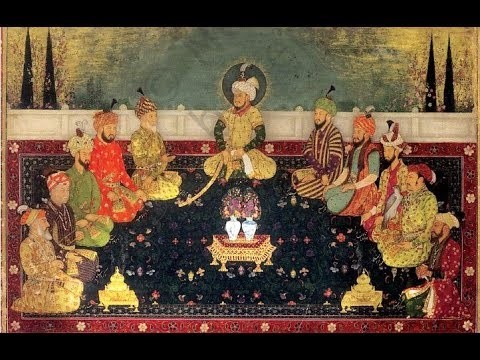
Babur was the founder of the Mughal empire which was established in 1526 after Babur defeated Ibrahim Lodi in the first battle of Panipat.
Thus a new epoch and a new empire in India began, lasting for nearly three centuries beginning from 1526 to 1857. Six major rulers of this dynasty, Babur, Humayun, Akbar, Jahangir, Shah Jahan and Aurangzeb, known as the “Great Mughals”, left their mark on Indian
history. The empire declined after the death of Aurangzeb in 1707.
Zaheeruddin Mohammad Babur(1526-30AD)

- Babur ascended the throne at Farghana (Uzbekistan), in 1494 at the age of twelve after the death of his father.
- The situation in Central Asia was not stable and Babar had to face a lot of resistance from the nobility itself.
- Although he was able to capture Samarqand but very soon he had to retreat because of desertion of some of his nobles. He also lost Farghana to the Uzbegs.
- After years of wandering he seized Kabul in 1504.
- During this whole period he had plans of moving towards Hindustan. And finally from 1517 onwards he made decisive moves towards India.
- Meanwhile in India there was conflict between some Afghan chiefs with Ibrahim Lodi. Prominent among them was Daulat Khan Lodi, the Governor of a large part of Punjab.
- The Rajput king of Mewar Rana Sanga was also asserting his authority against Ibrahim Lodi and was trying to increase his area of influence in north India.
- Both of them sent word to Babur to invade India. Invitations from Rana Sanga and Daulat Khan Lodi might have encouraged Babur’s ambitions.
- Between 1519 and 1524 he invaded Bhera, Sialkot and Lahore.
- Finally, in 1526 Ibrahim Lodi and Babur’s forces met at Panipat .
- Babur had an active army of only 12000 soldiers while Ibrahim’s army had an estimated strength of 100,000 soldiers. When face to face in the battle field Babur’s tactics were unique. He effectively applied the Rumi (Ottoman) method of warfare.
- Cannons were an important addition in sixteenth-century warfare. Babur used them effectively in the first battle of Panipat.

– use of cannons in first battle of panipat
- Babur had conquered Delhi and Agra, but he still had to suppress the Rajputs and the Afghans.
- Babur decided to take on Rana Sanga of Chittor, who as ruler of Mewar, had a strong influence over Rajasthan and Malwa.
- The forces of Babur and Rana Sanga met at Khanwa, a place near Fatehpur Sikri. Rana Sanga was defeated in 1527 and once again the superior military tactics of Babur succeeded. With the defeat of Rana the biggest challenge in north India was shattered. (Battle of khanwa 1527).
- Though the Mewar Rajputs received great shock at Khanwa, Medini Rai at Malwa was still threatening to challenge the authority of Babur.
- In the neat year Babur defeated Medini Rai in Chanderi. (Battle of Chanderi 1528).
- In the subsequent year Babur encountered Afghans(Ibrahim Lodi’s brother Mohammad Lodi) , and defeated them in Battle of Ghagra 1529.
- Babur died in the year 1530AD.
- He was a scholar of Persian and Arabic languages.
- He wrote his autobiography, Tuzuk-i-Baburi in Turki language. Later it was translated into Persian and other languages.
Nasiruddin Mohammad Humayn (1530-1540 ; 1555-56)

- After the death of Babur in 1530, his son Humayun succeeded him.
- Humayun means “fortune” but he remained the most unfortunate ruler of the Mughal Empire.
- Humayun, a cultured and learned person, was not a soldier like his father.
- He was faced with the problems of a weak financial system and the predatory Afghans.
- The growth of Afghan power in the regions around Bihar and Uttar Pradesh under the leadership of Sher Khan (later Sher Shah) made Humayun to initiate action. Defeating the Afghans at Daurah in 1532 Humayun besieged the powerful fort of Chunar.
- However in 1539 Sher Shah Suri defeated Humayun in Battle of Chausa. Somehow Humayaun managed to escape from battle ground.
- In the next year SherShah Suri confronted Humayun in Kannauj and defeated him completely. (Battle of Kannauj 1540)
- Sher Shah started his independent rule.
Sher Shah Suri(1540-55)

- Farid, who later came to be called Sher Khan and subsequently Sher Shah, was son of a Jagirdar under the kingdom of Jaunpur. His father Hasan Khan Sur held the jagir of Sasaram in Bihar during the rule of Lodis.
- After defeating Humayun he became sovereign ruler in the year 1540 and assumed the title of Sher Shah.
- After a gap of 14 years Sher Shah succeeded in establishing the Afghan rule again in India in 1540(Lodis were the first Afghans to rule)
- Sher Shah and his successors ruled for 15 years. This period is known as the period of second Afghan Empire.
- He defeated and conquered Malwa in 1542 which was followed by Chanderi. In Rajasthan he led campaigns against Marwar, Ranthambhore, Nagor, Ajmer, Merta Jodhpur and Bikaner. He defeated rebellious Afghans in Bengal. By 1545 he had established himself as the supreme ruler from Sindh and Punjab to whole of Rajputana in the West and Bengal in the East.
- Now he turned towards BundelKhand. Here while besieging the fort of Kalinjar he died in 1545 in an accidental blast of gun powder.
- After Sher Shah’s death in 1545 his successors ruled till 1555 when Humayun reconquered India.
Sher Shah’s Reforms:
- He made his government highly centralised.
- The king was assisted by important ministers:
Diwan –i- Wizarat – also called as Wazir – in charge
of Revenue and Finance.
2. Diwan-i-Ariz – in charge of Army.
3. Diwan-i-Rasalat- Foreign Minister.
4. Diwan-i-Insha- Minister for Communications. - Sher Shah’s empire was divided into forty seven sarkars. Chief Shiqdar (law and order) and Chief Munsif (judge) were the two officers in charge of the administration in each sarkar.
- Each sarkar was divided into several parganas. Shiqdar (military officer), Amin (land revenue), Fotedar (treasurer) Karkuns (accountants) were in charge of the administration of each pargana.
- Sher Shah had also improved the communications by laying four important highway They were: 1. Sonargaon to Sind 2. Agra to Burhampur 3. Jodhpur to Chittor and 4. Lahore to Multan.
- He extended the Grand Trunk Roadfrom Chittagong in the frontiers of the province of Bengal in northeast India to Kabul in Afghanistan in the far northwest of the country.
- Malik Muhammad Jayasi wrote the famous Hindi work Padmavat during his reign.
- He started building a new walled city in Delhi, which later came to be known as Purana Qila (Old Fort).
- He built his own mausoleum in Sasaram.
Humayun (1555-1556)
Akbar(1556-1605)

- Akbar was only thirteen years old at the time of Humayun’s death. When his father died, Akbar was at Kalanaur in Punjab and therefore his coronation took place in Kalanaur itself in 1556.
- It was his tutor and Humayun’s favourite and confidant Bairam Khan, who served as the regent of the Mughal emperor from 1556 to 1560.
- As a conqueror Akbar triumphed all over North India. The first four years of Akbar’s
rule saw the expansion of the Mughal empire from Kabul to Jaunpur, including
Gwalior and Ajmer, under his regent Bairam Khan. - One of the major achievements of his regency period was the defeat of Hemu and the Afghan forces in the second battle of Panipat in 1556, who were posing a serious threat to the Mughal Empire.
Akbar’s Military Conquests:
- Malwa was conquered in 1562 from Baz Bahadur who was made a mansabdar in Akbar’s court.
- The Gondwana region of central India was annexed after a fierce battle with Rani Durgavati and her son Vir Narayan in 1564.
- Akbar conquered Gujarat from Muzaffar Shah in 1573.Akbar built new capital Fathepur sikri in memory of this victory.
- In the Battle of Haldighati, Rana Pratap Singh was severely defeated by the Mughal army led by Man Singh in 1576. Following the defeat of Mewar, most of the leading Rajput rulers had accepted Akbar’s suzerainty.
- Defeated Daud Khan, the Afghan ruler of Bihar and Bengal, both the provinces were annexed to the Mughal empire in 1576.
- Akbar’s forces had occupied Khandesh region in 1591.
- Chand Bibi defended Ahmednagar against the Mughal forces.

– A depiction of the traditional account of the battle of Haldighati by the painter Chokha

Rajput policy:
The Rajput policy of Akbar was notable. He married the Rajput princess, the daughter of Raja Bharamal. It was a turning point in the history of Mughals. Rajputs served the Mughals for four generations. Many of them rose to the positions of military generals. Raja Bhagawan Das and Raja Man Singh were given senior positions in the administration by Akbar. One by one, all Rajput statessubmitted to Akbar.
Religious policy:
- He abolished the pilgrim tax and jiziya
- In 1575, he ordered for the construction of Ibadat Khana (House of worship) at his new capital Fatepur Sikri.
- Akbar invited learned scholars from all religions like Hinduism, Jainism, Christianity and Zoroastrianism.
- In 1582, he promulgated a new religion called Din Ilahi or Divine Faith. It believes in one God. It contained good points of all religions.
- He propagated a philosophy of Sulh-i-Kul (peace to all).
- In 1582, he discontinued the debates in the Ibadat Khana as it led to bitterness among different religions
- Badauni, a contemporary author, was bitter critic of Akbar’s religious experiment.
- Sheikh Mubarak was religious guru of Akbar.
- Akbar’s new religious policy was drafted by Abul Faizi.

– Discussions in Ibadat khana
Jahangir(1605-1627)

- Akbar was succeeded by his son Salim with the title Nur-ud-din Jahangir.
- He was Akbar’s son by a Rajput wife.
- His ascension was challenged by his eldest son Prince Khusrau who staged a revolt with the blessings of Sikh Guru Arjun Dev.
- Prince Khusrau was defeated, captured and blinded, while Guru Arjun Dev was executed.
- In 1608 Ahmad Nagar in the Deccan had declared independence under Malik Ambar.
- During the reign of Jahangir there was no addition to the Mughal territory in Deccan.
- Jahangir’s reign witnessed the visit of two Englishmen – William Hawkins and
Sir Tomas Roe. While the former could not get the consent of the Emperor for
establishing an English factory in India, the latter, sent as ambassador by King
James I, succeeded in securing permission to establish a British factory at Surat. - In 1611, Jahangir married Mehrunnisa who was known as Nur Jahan (Light of World).
- Nur Jahan dominated the royal household and set new fashions based on Persian traditions. She encouraged Persian art and culture in the court.
- Nur jahan became the real power behind the throne.
- The political intrigues that prevailed because of Nur-Jahan, led Prince Khurram(Shah Jahan) to rebel against his father.
- Nur-Jahan, who ruled the empire for ten years, lost her power and influence
after Jahangir’s death. - Jahangir died near Lahore (on the way from Kashmir to Lahore). He was buried in Lahore.

-Sir Thomas Roe in Jahangir’s court

-Tomb of Jahangir , Lahore
Shah Jahan(1627-1658)

- After Jahangir’s death in 1627, Shah Jahan reached Agra with the support of the nobles and the army and ascended the throne.
- Shah Jahan launched a prolonged campaign in the northwest frontier to recover Kandahar and other ancestral lands. But was unable to control Kandhar.
- His Deccan policy was more successful. He defeated the forces of Ahmadnagar and annexed it. Both Bijapur and Golkonda signed a treaty with the emperor.
- Shah jahan defeated Shivaji’s father shahji Bhonsle.
- In 1631 Shah Jahan’s wife Mumtaz mahal passed away at Burhanpur. In memory of her Shah jahan started constructing Musoleum at Agra(Taj mahal).
- He was contemporary to Louis XIV of France.
- In his reign the famous Peacock Throne was made for the King.
- Europeans like Bernier (French physician and traveller), Tavernier (French gem
merchant and traveller), Mandelslo (German adventurer and traveller), Peter Mundy (English Trader) and Manucci (Italian writer and traveller) visited India during the reign of Shah Jahan and left behind detailed accounts of India. - During the last days of Shah Jahan, there was a contest for the throne amongst
his four sons. - Dara Shukoh, the eldest, was the favourite of his father.
- A war of succession broke out between the four sons of Shah Jahan in which Aurangzeb emerged victorious.
- Aurangzeb imprisoned Shah Jahan and crowned himself as the Mughal emperor. Shah Jahan died broken hearted as a royal prisoner in January 1666 and was buried in the Taj Mahal.
Aurangazeb(1657-1707)

- He assumed the title Alamgir, World Conqueror.
- His military campaigns in his first ten years of reign were a great success. He suppressed the minor revolts. But he faced serious difficulties in the latter part of his reign
- The Jats and Satnamis and also the Sikhs revolted against him. These revolts were induced by his harsh religious policy.
- Aurangazeb was basicallu puritan (religious) in nature. He imposed jijiya on Hindus.
- He was influenced by Nakshabandi sufi order.
- Prince Akbar rebelled against his father Aurangazeb, in this connection ninth Guru of Sikhs Guru Tegbahadur was executed by Aurangazeb.
- Deccan policy: Te Deccan policy of Aurangzeb was motivated by the policy of containing the growing influence of the Marathas, the rebellious attitude of the Shia kingdoms of Deccan like Golkonda and Bijapur and to curtail the rebellious activities of his son Akbar who had taken refuge in the Deccan. Aurangzeb came to the Deccan in 1682 and remained in the Deccan till his death in 1707.
- Aurangazeb annexed Golconda and Bijapur.
- In fact, the destruction of the Deccan kingdoms
was a political blunder on the part of Aurangazeb. The barrier between the Mughals and the Marathas was removed and there ensued a direct confrontation between them. Also, his Deccan campaigns exhausted the Mughal treasury. According to J.N. Sarkar, the Deccan ulcer ruined Aurangazeb. - The Marathas under Shivaji were a threat to Aurangzeb.
- Aurangzeb sent two of his great generals Shaista Khan and Jai Singh
one after the other to capture Shivaji. Jai Singh captured Shivaji and took him to
Delhi but Shivaji managed to escape to the Deccan. - Shivaji, employing guerrilla tactics, defied the Mughal forces till his death at the age of 53 in 1680.
- Aurangazeb was severely tested by the Marathas till his death in 1707 as the sons of Shivaji continued the rebellion.
- The death of Aurangzeb in 1707 marked a watershed in Indian history as the Mughal empire virtually came to end even though the weak successors of Aurangzeb held the throne the next 150 years.

Administration in Mughal Empire
- The Mughals retained many features of the administrative system of the Sultanate and Shershah.
- Under Shershah the administrative units of Pargana (a group of villages), sarkar (a group of parganas) and groups of sarkars (some what like subas or province) were placed under specific offices
- The Mughals formalized a new territorial unit called suba. The Mughal empire was divided into twelve provinces or subas by Akbar.
- Institutions of Jagir and Mansab system were also introduced by the Mughals
Mansabdari System
Under this system every officer was assigned a rank (mansab).The lowest rank was 10 and the highest was 5000 for the nobles. Princes of royal blood received even higher ranks. The ranks were divided into two – zat and sawar. Zat means personal and it fixed the personal status of a person. Sawar rank indicated the number of cavalrymen of a person who was required to maintain. Every sawar had to maintain at least two horses. The mansab rank was not hereditary. All appointments and promotions as well as dismissals
were directly made by the emperor.
Land Revenue System:
- Akbar went for revenue experimentation in his administration .
- The revenue policies of Alauddin Khilji and Sher Shah Sur formed the base for Mughal revenue system.
- In the year 1581 revenue minister Raja Todarmal reorganized the whole land revenue system. This system is known as Zabti or bandobast
- According to this system land was measured and classified based on the fertility of soil as,
- Polaj- cultivated every year
- Parauti – once in two years
- Chachar- once in three or four years
- Banjar-once in five or more years

Literature during Mughals
- Persian, Sanskrit and regional languages developed during the Mughal rule.
- Persian was the language of administration in Mughal Empire.
- The greatest contribution in the field of literature during the Mughal rule was the development of Urdu as a common language of communication for people speaking different dialects.
- Babur wrote his autobiography, Tuzuk-i-Baburi in Turki language.
- This autobiography gives details of flora and afauna in India.

– Illustrations in the Baburnama regarding the fauna of India.
- Babarnama(translation of tuzuk I baburi) was written in Persian by Abdul Rahim Khan.
- Abdul Fazl has written Akbarnama (history of Akbar) and Ain-i-Akbari(administration book).
- Jahangir hasitten his autobiography as Tuzuk-i-jahangiri.
- Mutamid khan has written biography of Jahangir as Iqbalnamah-i-Jahangir.
- Shahjahan’s biography padshanamah was written by two author. They were Abdul Hamid lahori and Inayat Khan. Inayat khan wrote shahjahan namah.
- Persian literature was enriched by translations of Sanskrit works.
- The Mahabharata was translated under the supervision of Abul Faizi, brother of
Abul Fazal and a court poet of Akbar. - Dara Shikoh translated the Bhagavat Gita and Upanishads into the Persian language. His most famous work, Majma-ul-Bahrain.
- Badauni was bitter critic of Akbar. He translated Mahabharata into Persian as Razanamah.
- Regional languages such as Bengali, Oriya, Rajasthani and Gujarathi had also developed during this period.
- From the time of Akbar, Hindi poets were attached to the Mughal court. The most influential Hindi poet was Tulsidas, who wrote the Hindi version of the Ramayana, the Ramcharitmanas.
- Jaganath Pandithraya , court poet of Shahjahan has written two Sanskrit books Ganga Lahari and Rasagangadharam.

– Abul Fazal presenting Akbarnama to Akbar
Painting during Mughals
Architecture during Mughals
- The advent of the Mughals brought a new era in architecture.
- Indo-Islamic architecture reached its zenith during this period
- The first building of this rule was Humayun’s Tomb at Delhi. Red sandstone was used in this building. It has a main gateway and the tomb is placed in the midst of a garden. Many consider it a precursor of the Taj Mahal
- Akbar built forts at Agra and Fatehpur Sikri. The Buland Darwaza reflects the grandeur of the mighty Mughal Empire. This building was made following Akbar’s victory over Gujarat
- The tomb of Salim Chishti, Palace of Jodha Bai, Ibadat Khana, Birbal’s Houseand other buildings at Fatehpur Sikri reflect a synthesis of Persian and Indian elements.
- During the reign of Jehangir, Akbar’s Mausoleum was constructed at Sikandra near Agra. He built the beautiful tomb of Itimad-ud-daulawhich was built entirely of marble.
- Shahjahan was the greatest builder amongst the Mughals. He used marble extensively. Decorative design in inlay work, (called pietra duro) beautiful arches and minarets were the features of his buildings
- The Red Fort and Jama Masjid of Delhi and above all the Taj Mahal are some of the buildings built by Shahjahan.

-Humayun Tomb

– Buland Darwaza Fathepur Sikri


– Itamad-ud-Daulah’s tomb